

The short answer
The wreck of Titanic was found on 1 September 1985 by a team led by Robert Ballard and Jean-Louis Michel. It lies about 3,800 metres (12,500 feet) deep, roughly 370 miles south-southeast of Newfoundland, broken into two main pieces about 600 metres apart.

ONE OF THE GREAT MYSTERIES OF THE TWENTIETH CENTURY IS SOLVED

The Titanic Wreck is found seven decades on.
On the first of September 1985, one of the greatest mysteries of the twentieth century was solved as three supercharged lights strained to break through the murky depths of the Atlantic Ocean floor to reveal a sharp mass rising from below which clearly did not fit with its surroundings.
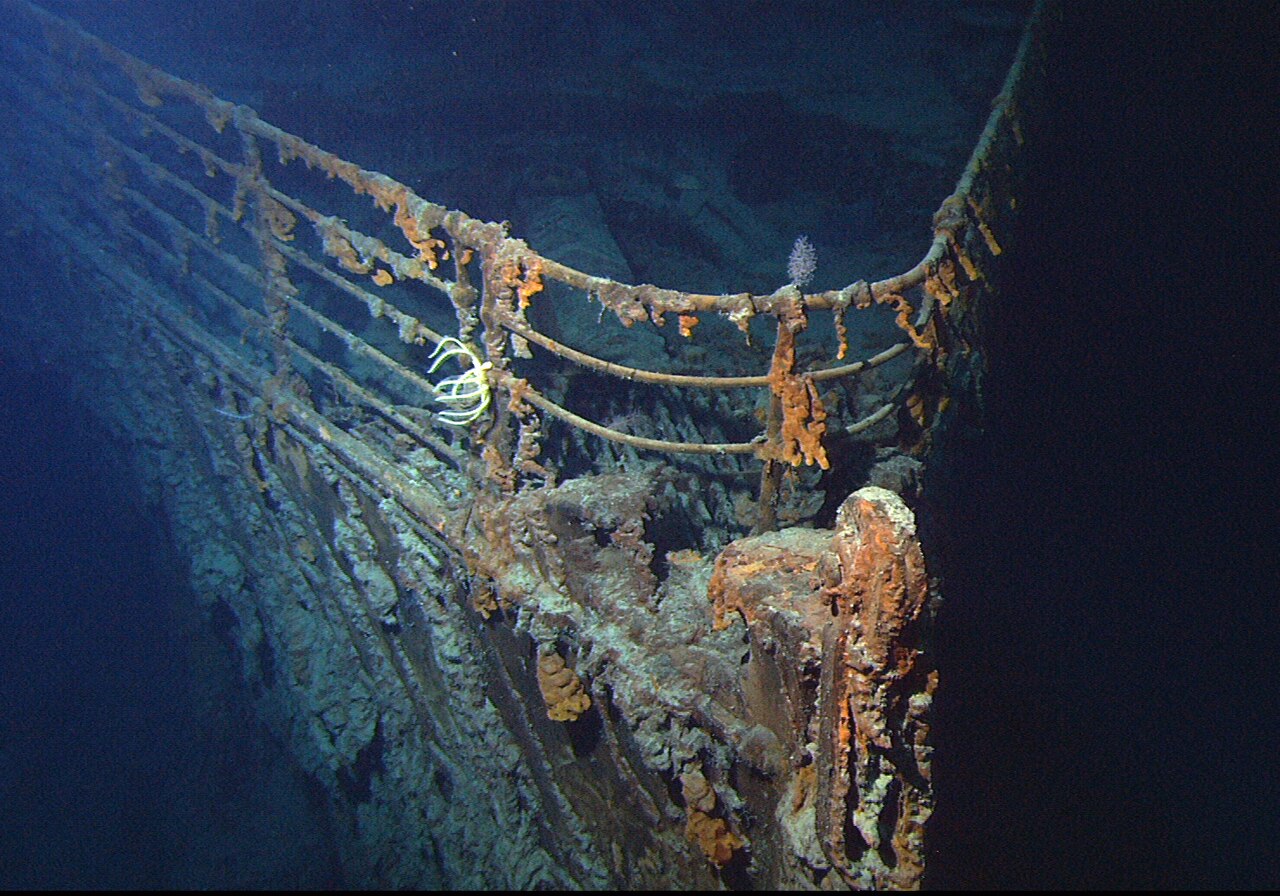
Those lights were attached to a tiny three-person deep-water towed camera sled called Argo, deployed from the research ship Knorr by a team led by Dr Robert Ballard (the crewed submersible Alvin first reached the wreck in July 1986), a renowned oceanographer and underwater archaeologist and that sharp mass was the bow of the Titanic.
Dr Robert Ballard is probably the greatest marine archaeologist of all time before uncovering the Titanic wreck, but up until discovering Titanic, he was only known to a handful of people who needed a man of such knowledge and skills.
Within moments Ballard and his crew realized they were the first people to lay eyes on the Titanic in over 73 years as they confirmed portholes, cabins and items that correlated perfectly with blueprints of Titanic.
Alvin drifted alongside the rusted mass of the Titanic bow for nearly an hour before technical issues, and Mother Nature deemed it must make its two and a half-hour ascent to share this news with the world.
This successful voyage was the bottom of the ocean floor was the culmination of many failures, hunches and research Ballard and many others had dreamt of from the moment the Titanic slipped towards its icy grave on 15 April 1912.
Texan oil millionaire Jack Grimm had funded a series of searches for Titanic in 1980–83, before Ballard’s successful 1985 expedition but similar to his efforts to locate Noah’s Ark, the Loch Ness Monster, and Big Foot the Titanic refused to share its secrets with the world. Grimm grew increasingly frustrated with his search for the Titanic as it was an object that had to exist and the reports and data he had relied upon from the Carpathia – The ship that was first on the scene after Titanic’s sinking was eventually proven to be inaccurate by about 13 nautical miles (24 kilometres)
Robert Ballard
“It is a quiet and peaceful place – and a fitting place for the remains of this greatest of sea tragedies to rest.”
NEWS REPORT SEPTEMBER 1, 1985 – TITANIC IS DISCOVERED
Facts about the Titanic Wreck
HOW DEEP IS THE TITANIC WRECKAGE?
The RMS Titanic wreck lies at a depth of about 12,500 feet (3.8 km; 2.37 miles), about 370 miles (600 km) south-southeast off the coast of Newfoundland.
WHO FOUND THE TITANIC WRECKAGE?
Seventy-three years after the ship sank, a joint U.S. and French expedition located the RMS Titanic wreckage. Led by Dr Robert Ballard and Jean-Louis Michel, the infamous wreck was found about 370 miles south-southeast of Newfoundland.
RECENT FOOTAGE OF THE TITANIC WRECK
Ballard’s first discovery was that the Titanic was not in one piece and was in a heavily rusted state. The Bow and stern were separated by approximately 640 meters (2000 feet.) which instantly ruined some misguided dreams of refloating her as a living museum. Scientists had theorized that due to the ocean’s depths and temperature in the region that Titanic lay, it might have avoided the ravages of corrosion, wood disintegration, and possibly even may contain some well-preserved skeletons. This was not the case.
The course Titanic intended to take

The Location of the Titanic Wreckage
The discovery of the wreckage silenced many of the conspiracy theories and myths surrounding the sinking of Titanic. The first being its location. The Titanic lay in three locations at a depth of 3840 metres (12,600 feet) at the following coordinates. This was determined by the known voyage of Titanic and a mix of eyewitness accounts from the time.
The stern lies at 41°43’35” N 49°56’54” W.
The boilers lay at 41°43’32” N 49°56’49” W.
The bow lies at 41°43’57” N 49°56’49” W.

The Titanic was found at an incredible depth, and this diagram goes some way to explaining why it took 73 years for the technology to provide us with the tools to locate it.
Titanic was so hard to find was in part because it lay in some of the deepest waters on the planet.
Some items have been salvaged from the Titanic wreck, which has caused an element of debate about whether the Titanic should remain untouched as a memorial to those who died on board or if these items teach us a great deal more about Titanic on display in Museums and exhibitions around the world.

ROBERT BALLARD SPEAKS ABOUT THE IMPACT OF DISCOVERING AND PRESERVING TITANIC
Titanic Wreckage Image Gallery


Frequently asked questions
How deep is the Titanic wreck?
About 3,800 metres (12,500 feet) below the surface of the North Atlantic.
Who found the Titanic wreck?
A French and American team led by Jean-Louis Michel of IFREMER and Robert Ballard of the Woods Hole Oceanographic Institution, on 1 September 1985.
Keep exploring: The Titanic sinking · Titanic conspiracy theories · Teaching the Titanic? See our Titanic resources for teachers.