


TITANIC: SEA TRIALS & LAUNCH
The Launch of Titanic
Before Titanic could carry a single passenger, she had to be launched into the water, fitted out and then tested at sea. The launch in May 1911 and the sea trials in April 1912 bookend the year in which an empty hull became a working ship.
The short answer
Titanic was launched in Belfast on 31 May 1911 and spent the next ten months being fitted out. Her sea trials took place on 2 April 1912, and she left Belfast that evening for Southampton, arriving just after midnight on 4 April.
Harland & Wolff began building Titanic for the White Star Line in Belfast in March 1909, alongside her sister ship Olympic. She was meant to outclass every other liner in size and comfort, with features such as a gymnasium, a swimming pool and a Turkish bath that most ships of the day did not offer.
On 31 May 1911 the bare hull, without engines, funnels or interiors, slid down the slipway into the River Lagan in about a minute. A crowd of around 100,000 people turned out to watch, including shipyard workers, their families, invited guests and reporters. White Star did not christen its ships, so there was no bottle of champagne.
For Belfast, the launch was a moment of real pride. Thousands of local men had spent two years building the hull, and the ship showed off the skill of a city that was then one of the great shipbuilding centres of the world. The launch was not the end of the work: it took another ten months to fit out the engines, funnels and interiors.
What happened during the Titanic Sea Trials?
By the spring of 1912 Titanic was ready to move under her own power for the first time. Tugs towed her down the River Lagan towards Belfast Lough, where her engines could finally be tested.
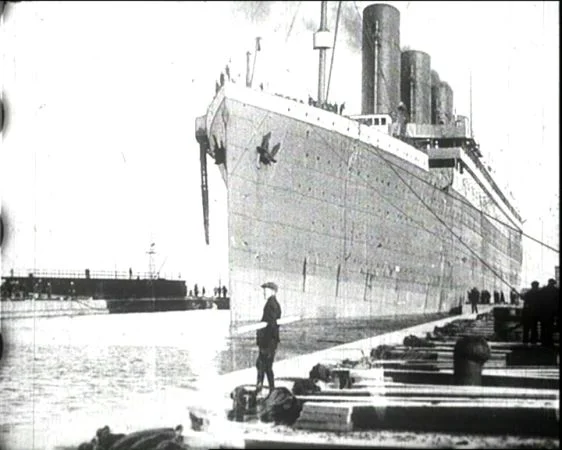
The trials were planned for 1 April 1912, but strong winds forced a delay of one day.
They took place on Tuesday 2 April 1912, only eight days before Titanic was due to leave Southampton on her maiden voyage.
Some historians see this tight schedule as part of a wider rush to get the ship into service. Others point out that one day of trials was normal for a new liner at the time, and that Olympic, built to the same design, had already been tested at sea the year before.
On board was a reduced crew of firemen, trimmers and greasers to run the engines, along with a handful of officers, White Star representatives, Thomas Andrews and his Harland & Wolff team, and Francis Carruthers, the Board of Trade surveyor. The new Marconi wireless equipment was also tested and tuned during the day.

The tests were designed to show how well the ship could be steered, how fast she could go and how quickly she could stop. They are the only measurements we have of how Titanic performed, and because she was never pushed to full power, they probably underestimate what she could do.
These are the figures usually quoted from the trials.
Top recorded speed: just under 21 knots (about 39 km/h)
Turning: she made a series of turns at different speeds, though the figures quoted for her turning circle vary from source to source
Stopping distance: about 850 yards (777 metres), taking 3 minutes 15 seconds

The trials lasted about twelve hours. Titanic was tested first in the sheltered waters of Belfast Lough and then out in the Irish Sea, running at different speeds and making a series of turns.
The most dramatic test was the emergency stop. Running at speed, the engines were thrown from full ahead to full astern. It took more than three minutes and almost half a mile of sea before the ship came to rest, which gives a sense of how hard it was for a ship this size to avoid an obstacle at speed.
Titanic was back in Belfast by about 7 pm. Carruthers signed the certificate that declared her seaworthy for twelve months, and about an hour later she left Belfast for the last time. The trip of about 570 nautical miles to Southampton passed without incident, and she arrived around midnight on 4 April to take on her crew, supplies and passengers.
The trials showed a ship that was fast, steady and easy to handle. They gave little warning of what was to come. To find out what went wrong on the night of 14 April, read our guide to the Titanic sinking.
Titanic Launch and Sea Trials Image Gallery


Frequently asked questions
When were Titanic’s sea trials?
On 2 April 1912, in Belfast Lough and the Irish Sea, lasting about twelve hours.
Keep exploring: Titanic construction and design · The Titanic voyage · Teaching the Titanic? See our Titanic resources for teachers.